
Purchasing homes with property represents one of the most significant decisions you'll make, combining the practicality of residential living with the added benefits of land ownership. Whether you're seeking space for a growing family, room for hobbies and recreation, or long-term investment potential, understanding the unique considerations of homes with property is essential. The Australian property market offers diverse opportunities, from spacious suburban blocks in established areas like Revesby, Padstow and Panania to rural-residential acreage properties that provide genuine lifestyle benefits alongside capital growth potential.
Understanding What Constitutes Homes with Property
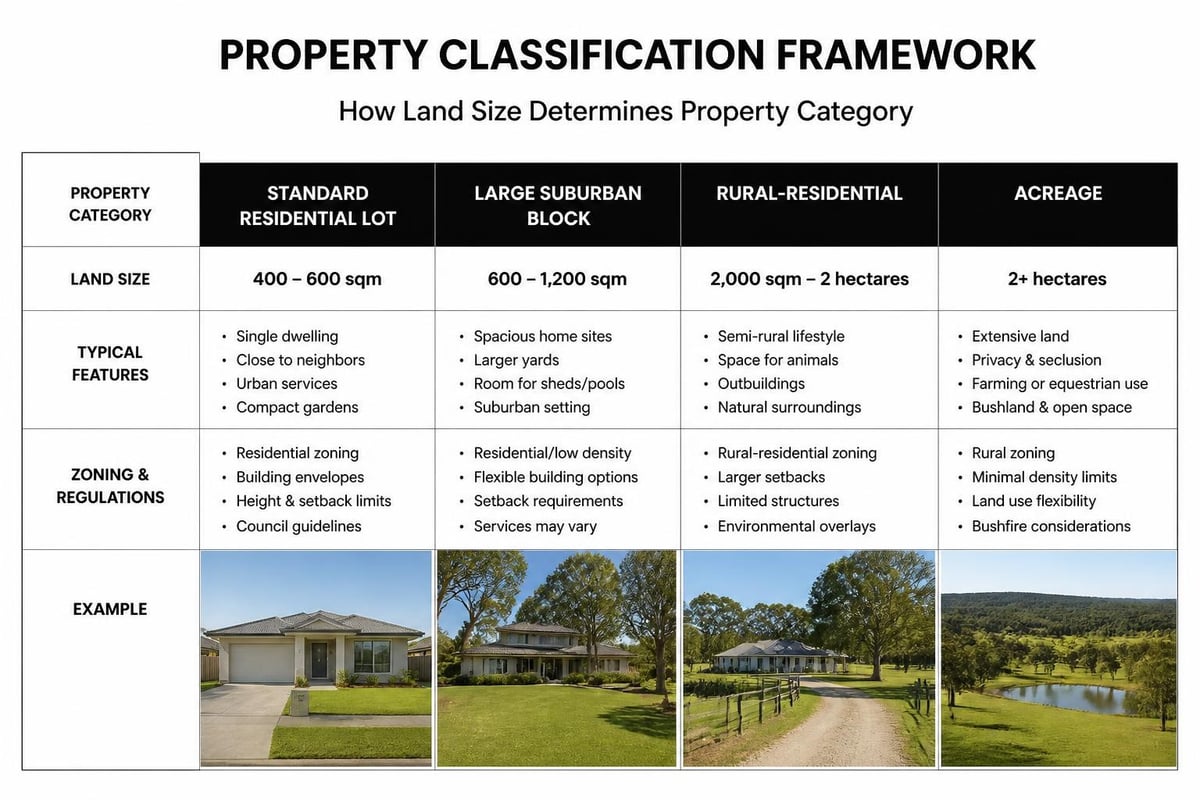
The term "homes with property" encompasses a broad spectrum of residential real estate that includes more than just the dwelling itself. At the most accessible level, you'll find generous suburban blocks ranging from 600 to 1,200 square metres, offering space for pools, sheds, gardens and outdoor entertaining areas whilst remaining within established suburban infrastructure.
Moving beyond traditional suburban allotments, homes with property can include:
- Rural-residential blocks typically ranging from 2,000 square metres to several hectares
- Acreage properties with sufficient land for agricultural pursuits, hobby farms or equestrian activities
- Corner blocks and battle-axe blocks offering unique land configurations with development potential
- Properties with secondary dwellings such as granny flats or studios that maximise land utility
The distinction matters because land size and configuration directly influence financing options, council regulations, maintenance requirements and long-term value appreciation. Properties with larger land holdings may face different zoning restrictions, require septic systems rather than town sewer connections, and present unique opportunities for subdivision or future development.
Land Size and Zoning Considerations
Understanding zoning regulations is fundamental when evaluating homes with property. Local councils designate land usage through zoning classifications that determine what activities are permissible, what structures can be built, and how the property can be developed or subdivided in future.
Residential zoning typically allows for standard dwelling construction and common domestic activities. Low-density residential zones may permit larger blocks with specific minimum lot sizes, whilst rural-residential zones bridge the gap between suburban living and genuine rural properties. Each classification carries implications for property taxes, infrastructure availability and permitted land uses.
Before committing to any property purchase, thorough due diligence on zoning matters is essential. Council planning certificates reveal current zoning, any development applications affecting neighbouring properties, and heritage or environmental overlays that might restrict future modifications.
Financing Homes with Property
Securing appropriate financing for homes with property requires understanding how lenders assess risk and value when significant land is involved. Standard residential mortgages typically cover properties on typical suburban blocks without complication, but larger land holdings introduce additional considerations for financial institutions.
Mortgage Eligibility Factors
Lenders evaluate several key factors when assessing loan applications for homes with property:
| Factor | Standard Block | Large Property/Acreage |
|---|---|---|
| Loan-to-Value Ratio | Up to 95% with LMI | Typically capped at 80% |
| Valuation Approach | Comparative market analysis | May require specialised rural valuer |
| Property Type | Standard residential | May be classified rural/lifestyle |
| Insurance Requirements | Standard home and contents | May require farm/rural policy |
The general property eligibility guidelines used by major lenders worldwide demonstrate how unusual property features, agricultural use, or significant acreage can affect financing availability. Whilst Australian lenders operate under different frameworks, similar principles apply regarding how land size and usage affect mortgage eligibility.
Properties with significant acreage or those located in rural areas may qualify for specialised loan products. The USDA property eligibility tool illustrates how rural property programs function internationally, though Australian buyers should investigate equivalent rural finance options through domestic agricultural lenders and regional banking institutions.
Deposit and Insurance Requirements
Homes with property often require larger deposits than standard suburban dwellings. Where you might secure a standard home with a 5-10% deposit plus lenders mortgage insurance, properties with substantial land holdings typically require 20% or more equity contribution, reflecting the perceived higher risk and lower liquidity of these assets.
Insurance considerations also become more complex. Standard home and contents policies may not adequately cover rural properties, structures like barns or sheds, farm equipment, or liability risks associated with livestock or agricultural activities. Specialised rural property insurance provides appropriate coverage but at higher premiums reflecting increased risks.
Evaluating Land Quality and Features
Not all land is created equal, and the quality, topography and characteristics of the property significantly influence its value, usability and long-term potential. When assessing homes with property, look beyond simple square metreage to understand what the land actually offers.
Topography and Drainage
Flat, well-drained land typically commands premium pricing because it's immediately usable for buildings, gardens, recreational spaces and potential future development. Sloping blocks present both challenges and opportunities, potentially offering better views and privacy whilst requiring more expensive site preparation for construction or landscaping.
Drainage is critical for properties of any size but becomes increasingly important as land size grows. Poor drainage leads to erosion, waterlogging, foundation issues and limitations on where structures can be positioned. Professional building and pest inspections should extend to land assessment, including soil testing where significant construction or landscaping is planned.
Key land quality indicators include:
- Soil type and quality (particularly relevant for gardens, landscaping or agricultural use)
- Natural water features such as creeks, dams or springs
- Existing vegetation, including protected native trees that may restrict clearing
- Easements or rights-of-way that limit usable land area
- Flood zone classification and historical flood data
- Slope percentages and stability of embankments or retaining structures
Utilities and Infrastructure
Homes with property outside established suburban areas may rely on alternative utility arrangements. Town water and sewer connections represent significant value, whilst properties requiring tanks, bores, and septic systems involve ongoing maintenance costs and operational considerations.
The EPA’s septic systems guidance provides comprehensive technical information about onsite wastewater management, though Australian systems must comply with state-specific regulations. Understanding septic maintenance requirements, installation costs for new systems, and compliance obligations is essential when evaluating properties without town sewer connections.
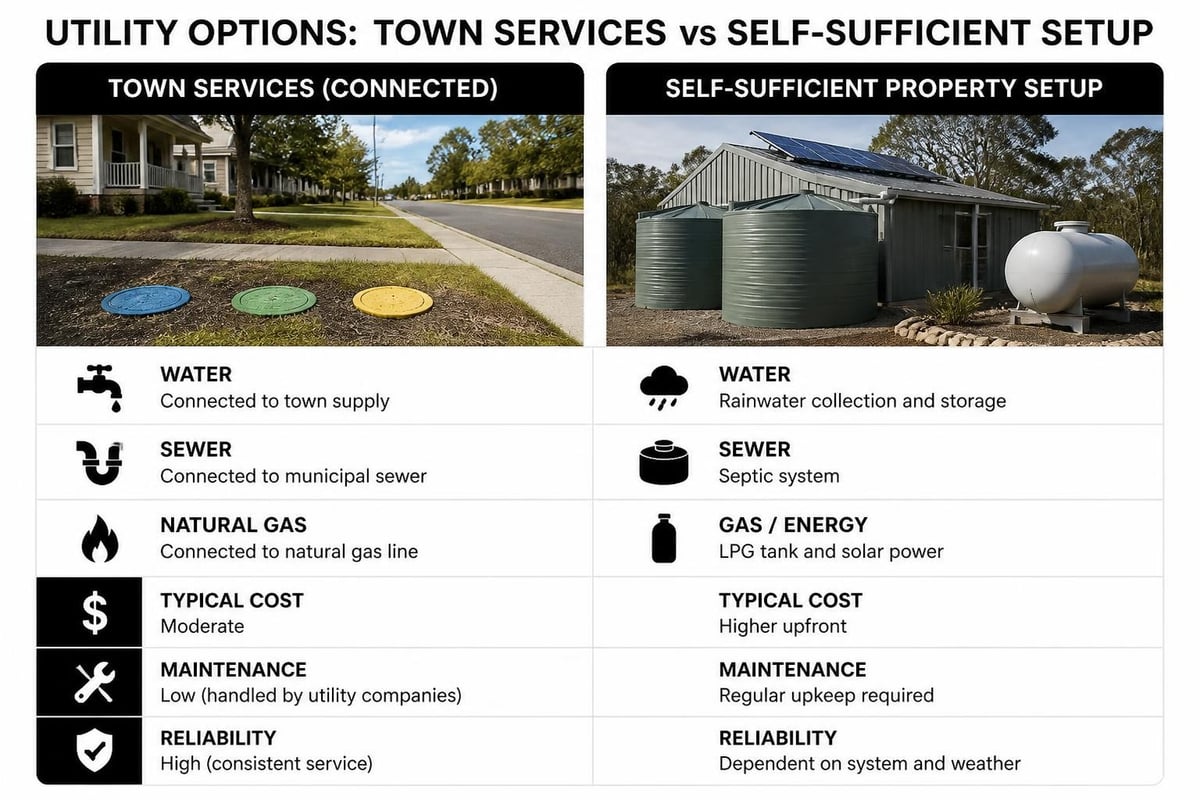
Electricity connectivity varies from standard grid connection to properties requiring underground cable installation at significant cost. Remote properties may rely on solar systems with battery storage, offering independence but requiring capital investment and ongoing system management.
Tax Implications and Financial Planning
The tax treatment of homes with property requires careful consideration, particularly when land size or usage creates complexities beyond standard residential ownership. Understanding these implications helps you make informed decisions and optimise your financial position.
Capital Gains Tax Considerations
Your principal place of residence typically enjoys full capital gains tax exemption when sold, but this exemption may be partially limited when the property includes significant land. The Australian Taxation Office applies specific rules regarding the main residence exemption on properties exceeding two hectares, potentially attributing some capital gain to the excess land.
The IRS Publication 530 demonstrates how tax authorities internationally treat land-related costs and basis calculations, though Australian taxpayers must follow ATO guidelines. Professional tax advice is essential when purchasing homes with property that may have blurred lines between residential and investment or agricultural purposes.
Ongoing Holding Costs
Larger properties generate higher ongoing costs that impact long-term affordability. Council rates increase with land value and size, water charges may include both fixed and usage components, and maintenance costs escalate with property size.
Additional holding costs to budget for include:
- Higher insurance premiums reflecting replacement costs and property risks
- Land care and maintenance including slashing, fire prevention and weed management
- Infrastructure maintenance for dams, fences, driveways and outbuildings
- Utility costs particularly where properties rely on tank water or alternative power
- Pest control and wildlife management relevant to larger rural properties
The Buying Process for Homes with Property
Purchasing homes with property involves additional due diligence steps beyond standard residential transactions. Thorough investigation protects your investment and prevents costly surprises after settlement.
Building and Pest Inspections
Standard building and pest inspections remain essential, but properties with significant land require expanded scope. Qualified inspectors should assess all structures including sheds, barns, stables and secondary dwellings, examine boundary fences and retaining walls, and evaluate water infrastructure such as tanks, pumps and dams.
Pest inspections on rural and semi-rural properties must consider different risk profiles, including termite activity in rural settings, rodent issues in outbuildings, and potential problems with agricultural structures that don't affect standard suburban homes.
Title and Survey Matters
Understanding exactly what you're purchasing requires careful review of title documents and surveys. The ALTA guide to title insurance explains how title issues, boundary disputes and survey discrepancies can affect property ownership, principles equally applicable to Australian property purchases.
For homes with property, particularly larger holdings or those with complex histories, consider:
- Obtaining an updated survey showing exact boundaries and improvements
- Reviewing title for easements, covenants or restrictions affecting land use
- Investigating rights of way that may impact privacy or future development
- Confirming boundaries match physical fencing and usage patterns
- Checking for unregistered interests or encumbrances
Professional conveyancing becomes even more critical when purchasing homes with property, ensuring all legal complexities are properly managed through to settlement.
Working with Real Estate Professionals
The complexity of homes with property transactions makes professional guidance invaluable. Experienced agents who specialise in properties with significant land holdings bring market knowledge, negotiation expertise and transactional competence that protect buyer interests.
When evaluating properties in established suburbs with larger-than-average blocks, working with an agent who understands local market dynamics ensures you receive accurate advice on fair market value, neighbourhood characteristics and future growth potential. Areas like Padstow, Revesby and Panania offer various block sizes, and understanding how land area affects pricing requires detailed local knowledge. For a detailed look at this suburb, see our guide to Real Estate Revesby and its 2026 market outlook.
Property Appraisal and Market Value
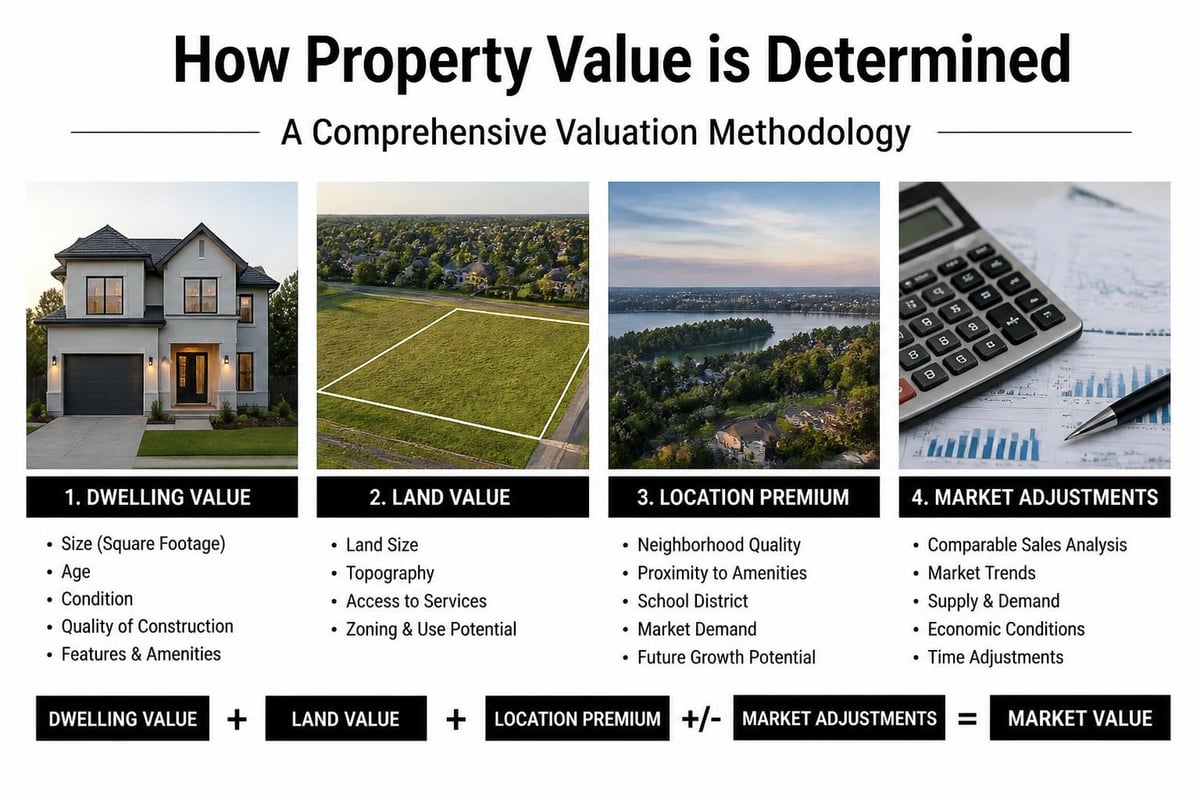
Accurate property appraisal forms the foundation of sound purchasing decisions. Unlike standard residential properties where comparable sales provide clear value indicators, homes with property often have fewer direct comparables, making professional appraisal expertise essential.
Property appraisals and market assessments provide data-driven valuations that account for land size, quality, location and improvement value. Professional agents analyse recent comparable sales, adjust for property differences, and provide realistic market value estimates that guide offer strategies and negotiation approaches.
Market Trends and Investment Potential
Homes with property have historically demonstrated strong capital appreciation, particularly in growth corridors where urban expansion gradually transforms larger rural holdings into premium residential real estate. Understanding market dynamics helps identify properties with superior investment potential.
Supply and Demand Dynamics
Limited supply of homes with property in established, well-serviced areas creates sustained demand pressure. As suburban density increases through townhouse and unit development, the relative scarcity of detached homes on generous blocks enhances their appeal and value.
Recent market trends show:
- Increasing buyer preference for space following lifestyle shifts toward home-based work
- Premium pricing for properties offering privacy, space and outdoor amenity
- Strong competition for well-located homes with subdividable land potential
- Growing interest in semi-rural properties within commuting distance of employment centres
Long-Term Value Drivers
Several factors contribute to sustained value appreciation for homes with property. Scarcity value increases as larger blocks become rarer through subdivision and higher-density development. Location within growth corridors benefits from infrastructure investment and population expansion, whilst properties offering genuine lifestyle benefits attract premium buyer segments less sensitive to economic cycles.
Development potential represents significant value for appropriately zoned homes with property. Blocks meeting minimum subdivision requirements offer future capital uplift through land division, whilst properties suitable for secondary dwelling construction generate both immediate rental income potential and enhanced resale value.
Lifestyle Benefits and Practical Considerations
Beyond financial metrics, homes with property deliver lifestyle advantages that motivate many buyers. Space for children and pets, room for hobbies and recreational pursuits, privacy from neighbours, and connection to outdoor living represent intangible benefits that enhance daily life quality.
Space Utilisation Opportunities
Larger properties accommodate activities impossible on standard suburban blocks. Serious gardeners create extensive vegetable plots and ornamental gardens, while families install swimming pools, tennis courts, or outdoor entertaining areas without compromising yard space.
Common space utilisation approaches include:
- Home-based business premises in appropriately zoned areas
- Workshop or studio space for hobbies and creative pursuits
- Vehicle storage for boats, caravans or vehicle collections
- Pet accommodation including kennels, catteries or stables
- Self-sufficiency activities such as orchards, chickens or productive gardens
Maintenance Realities
Whilst space offers opportunity, it also demands ongoing maintenance commitment. Larger properties require more time, effort and expense to maintain than standard suburban homes. Realistic assessment of your capacity and willingness to undertake this maintenance prevents buyer's remorse.
Consider whether you have the time, physical capability and financial resources for regular lawn maintenance, garden care, infrastructure upkeep and seasonal tasks like fire preparation. Properties requiring ride-on mowers, extensive irrigation systems, or specialised equipment represent ongoing operational commitments beyond standard home ownership.
Making the Right Choice
Selecting the right home with property requires balancing practical considerations, financial capacity and lifestyle aspirations. Neither the largest block nor the most affordable option necessarily represents the best choice; instead, the optimal property aligns with your specific needs, budget and long-term objectives.
Start by clearly defining your requirements, distinguishing between essential features and desirable extras. Consider how long you intend to own the property, whether resale or long-term holding drives your decision, and how the property fits within your broader financial planning.
Thorough due diligence protects your interests and prevents costly mistakes. Engage qualified professionals including building inspectors, conveyancers, financial advisers and experienced real estate agents who understand homes with property transactions.
When evaluating properties for sale, don't rush the decision. Properties with significant land holdings represent major financial commitments that warrant careful consideration, multiple inspections, and comprehensive investigation before committing.
First Home Buyers and Property Selection
First home buyers often focus on entry-level pricing without considering long-term suitability. Whilst smaller, more affordable homes might seem attractive initially, purchasing a home with adequate property from the outset can prove more cost-effective than upgrading within several years, incurring multiple transaction costs and potentially missing market growth.
Professional guidance helps first-time purchasers navigate the complexity of buying homes with property, understanding financing options, managing due diligence processes, and making confident decisions. Expert advice ensures you secure appropriate property at fair market value whilst avoiding common pitfalls that catch inexperienced buyers.
Purchasing homes with property requires careful evaluation of land quality, zoning regulations, financing options and lifestyle fit, but the rewards include space, privacy and strong long-term value appreciation. Whether you're searching for your first home, upgrading to accommodate a growing family, or seeking investment potential through land holdings, professional guidance ensures successful outcomes. Real estate sales agent Steven Cirillo specialises in residential property transactions across Padstow, Revesby, Panania and surrounding suburbs, combining extensive local market knowledge with honest, straightforward advice that helps buyers and sellers achieve exceptional results. Contact Steven today to discuss your property goals and receive expert assistance throughout your buying or selling journey.