
A real estate referral agent operates within a specialised niche of property services, connecting clients with qualified agents in markets outside their primary operating area. This arrangement benefits everyone involved: clients receive expert representation in unfamiliar territories, referring agents maintain client relationships whilst earning referral fees, and receiving agents gain qualified leads. Understanding how referral arrangements function, the regulatory framework governing them, and when they deliver the greatest value helps both agents and clients navigate property transactions more effectively across Australia's diverse property markets.
Understanding the Real Estate Referral Agent Model
The referral model in real estate addresses a fundamental challenge: clients frequently need assistance in markets where their trusted agent doesn't operate. Rather than abandoning the relationship, a real estate referral agent facilitates the introduction to a competent professional in the target location.
How Referral Arrangements Work
When an agent refers a client to another professional, they're creating a formal business relationship governed by written agreements. The referring agent identifies the client's needs, connects them with a qualified receiving agent, and steps back whilst maintaining periodic communication throughout the transaction.
Key components of referral arrangements include:
- Written agreements outlining responsibilities, timelines, and compensation
- Clear disclosure to all parties about the referral relationship
- Specific referral fees, typically expressed as a percentage of the receiving agent's commission
- Quality standards and service expectations for the receiving agent
- Communication protocols ensuring clients receive consistent updates
The National Association of Realtors provides comprehensive guidance on structuring these broker-to-broker arrangements, though Australian agents must also comply with local state-based regulations and licensing requirements.

Why Agents Choose Referral Networks
Real estate referral agents leverage their professional networks to deliver value beyond their geographic boundaries. An agent specialising in Padstow, Revesby, and Panania, for instance, might refer Sydney-based clients relocating to Brisbane or Melbourne, ensuring continuity of service quality even when direct representation isn't feasible.
This approach maintains client trust whilst generating income from relationships that might otherwise end. The referral fee compensates the original agent for their marketing investment, client acquisition costs, and the value of their established relationship.
Legal and Compliance Framework for Referrals
Australian real estate referral arrangements operate within strict regulatory boundaries designed to protect consumers and maintain industry integrity. Unlike informal recommendations, paid referrals require specific documentation and disclosure.
RESPA and International Considerations
Whilst Australian agents primarily operate under state-based regulations, understanding international frameworks proves valuable for cross-border transactions. The United States' Real Estate Settlement Procedures Act (RESPA) establishes clear boundaries between permissible referral fees and prohibited kickbacks-principles that inform best practices globally.
Australian regulations similarly distinguish between legitimate compensation for services rendered and improper inducements that might compromise professional judgement. The critical distinction centres on disclosure: clients must know when financial relationships influence agent recommendations.
| Compliance Requirement | Purpose | Consequence of Non-Compliance |
|---|---|---|
| Written referral agreement | Documents terms, responsibilities, fees | Disputes, unenforceable compensation |
| Client disclosure | Informs clients of financial relationships | Regulatory penalties, licence suspension |
| Licensing verification | Ensures receiving agent holds valid credentials | Liability exposure, invalid transactions |
| Fee transparency | Prevents hidden costs to consumers | Consumer protection violations |
State-Specific Referral Fee Regulations
Each Australian state and territory maintains distinct requirements for referral fee arrangements. New South Wales, where Padstow, Revesby, and Panania are located, requires explicit written disclosure when agents receive fees for referrals to service providers including other real estate professionals.
State real estate commission rules across various jurisdictions demonstrate the regulatory scrutiny applied to referral arrangements. Agents must verify current requirements in both their home state and the jurisdiction where the receiving agent operates.
Common state-level requirements include:
- Written consent from all parties before referral fees are paid
- Disclosure of fee amounts or percentages in advance
- Prohibition of referral fees to unlicensed individuals
- Documentation retention for audit purposes
- Restrictions on fee-splitting with non-agents
Structuring Referral Compensation
Referral fee structures vary based on transaction complexity, market conditions, and the level of involvement the referring agent maintains throughout the sale process. Understanding typical arrangements helps both referring and receiving agents negotiate fair terms.
Standard Fee Percentages and Calculations
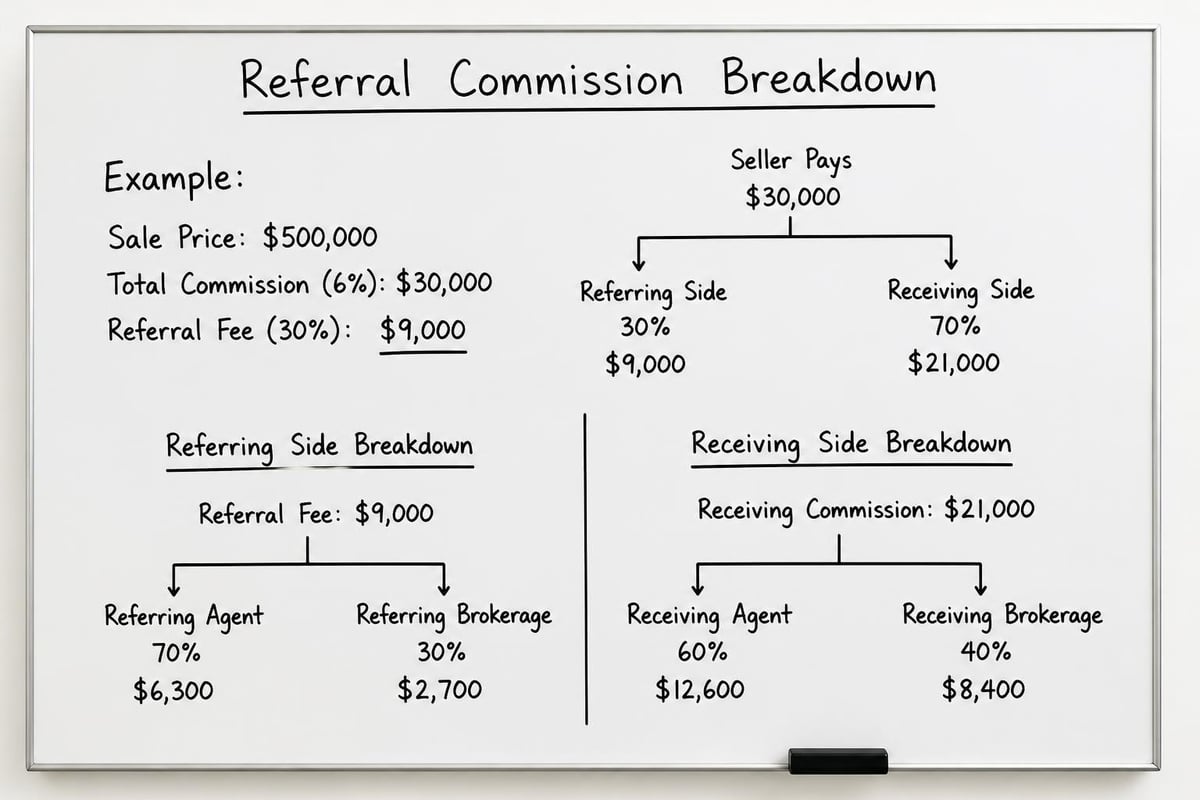
Most real estate referral agent arrangements involve a percentage of the receiving agent's commission rather than a flat fee. This aligns the referring agent's compensation with transaction success and scales appropriately across different property values.
Typical referral fees range from 20% to 35% of the gross commission earned by the receiving agent. For example, if a receiving agent earns $15,000 in commission on a property sale and agrees to a 25% referral fee, the referring agent receives $3,750.
Factors influencing referral fee percentages:
- Geographic distance between markets
- Level of ongoing involvement by the referring agent
- Quality and qualification level of the referred client
- Competitive dynamics in the receiving agent's market
- Complexity of the client's needs (first home buyers versus luxury properties)
Some arrangements involve tiered structures where referral percentages vary based on sale price thresholds or the number of referrals sent to the same receiving agent over time.
Tax Implications of Referral Income
Referral fees constitute taxable income for real estate professionals. The IRS provides detailed guidance on reporting requirements for referral payments, and Australian agents must similarly declare all referral income to the Australian Taxation Office.
Proper documentation proves essential for tax compliance. Agents should maintain records including:
- Executed referral agreements with payment terms
- Invoices issued for referral fees
- Payment receipts and bank statements
- Correspondence confirming client consent and disclosure
- Details of the underlying property transaction
Working with an accountant familiar with real estate industry practices ensures accurate reporting and identifies legitimate business expense deductions related to referral activities.
When to Use a Real Estate Referral Agent
Not every situation warrants a formal referral arrangement. Understanding when referrals deliver optimal value helps agents make strategic decisions that serve client interests whilst maintaining professional relationships.
Interstate Relocations and Geographic Transitions
Interstate moves represent the most common scenario for real estate referral agents. Clients relocating from Sydney to Brisbane, Melbourne, or regional areas require local expertise they can trust. A referring agent who knows the client's preferences, financial position, and property requirements can brief the receiving agent comprehensively, creating a smoother transition than the client starting fresh with an unknown professional.
First home buyers relocating for employment particularly benefit from referral relationships, as the referring agent can identify receiving agents with specific first-buyer expertise in the destination market.
Specialised Property Requirements Beyond Local Expertise
Certain property types or transaction structures require specialised knowledge beyond a general practitioner's scope. Luxury residences, waterfront properties, rural acreage, or heritage listings often demand niche expertise concentrated in specific markets or agent specialisations.
Rather than attempting to serve clients outside their core competency, agents acting as real estate referral agents connect clients with proven specialists. This maintains service quality whilst protecting the agent's reputation and the client's interests.
Investment Property Acquisitions in Emerging Markets
Property investors frequently seek opportunities in growth markets distant from their primary residence. An investor based in Sydney's inner west might identify strong opportunities in emerging Queensland or Victorian regional centres but lack the local market intelligence needed for confident decision-making.
A real estate referral agent relationship connects the investor with local professionals who understand:
- Suburb-level growth patterns and infrastructure development
- Rental yield trends and tenant demographics
- Local council planning proposals affecting future values
- Comparable sales data for accurate valuation
- Property management considerations for absentee landlords
This specialised local knowledge significantly improves investment outcomes compared to remote property acquisition attempts.
Building and Managing Referral Networks
Successful real estate referral agents cultivate extensive professional networks built on trust, reciprocity, and consistent service quality. These relationships develop through deliberate networking strategies rather than chance encounters.
Identifying Quality Referral Partners
The receiving agent's performance directly reflects on the referring agent's judgement. Selecting referral partners requires due diligence beyond simple licensure verification.
Evaluation criteria for referral partners include:
- Proven track record with measurable sales results
- Client testimonials and satisfaction indicators
- Professional designations and continuing education
- Communication responsiveness and transparency
- Ethical standing and regulatory compliance history
- Market knowledge depth in their operating area
Many successful agents develop relationships with two or three trusted professionals in key markets, creating backup options if their primary contact is unavailable or unsuitable for a specific client's needs. Understanding how many real estate agents operate in different markets helps identify competitive landscapes and potential partners.
Formalising Referral Agreements
Written agreements protect all parties whilst ensuring clarity around expectations and compensation. While referral fee agreement templates provide useful starting points, consulting with a solicitor familiar with real estate transactions ensures compliance with local requirements.
| Agreement Component | Required Details | Purpose |
|---|---|---|
| Parties to agreement | Full names, licence numbers, brokerages | Legal identification |
| Client information | Name, property type, transaction side (buyer/seller) | Scope definition |
| Referral fee | Percentage or amount, payment timeline | Compensation clarity |
| Service standards | Communication frequency, reporting requirements | Quality assurance |
| Termination provisions | Notice requirements, fee treatment if terminated | Exit strategy |
| Dispute resolution | Mediation or arbitration requirements | Conflict management |
These agreements should be executed before introducing clients to receiving agents, preventing misunderstandings about compensation or responsibilities.

Recent Industry Changes Affecting Referrals
The real estate industry continues evolving, with regulatory changes and market dynamics reshaping how referral arrangements function. Staying informed about these developments ensures compliance whilst maximising referral opportunities.
NAR Settlement Impact on Australian Practices
Whilst primarily affecting United States markets, the NAR settlement and related MLS changes have prompted global discussions about commission transparency and buyer representation agreements. Australian agents should monitor whether similar reforms emerge domestically, potentially affecting how referral fees are disclosed and negotiated.
The core principle-that consumers deserve clear information about agent compensation and conflicts of interest-aligns with existing Australian consumer protection frameworks. Proactive disclosure practices position agents favourably regardless of future regulatory developments.
Digital Platforms and Referral Marketplaces
Technology platforms now facilitate referral connections beyond traditional networking relationships. These marketplaces match clients with agents based on location, specialisation, and performance metrics, often automating referral fee arrangements.
Advantages of digital referral platforms:
- Broader access to qualified agents nationwide
- Standardised vetting and credentialing processes
- Automated documentation and compliance tracking
- Performance data and client review transparency
- Reduced administrative burden for referral processing
Considerations before using platforms:
- Fee structures may be less negotiable than direct relationships
- Personal relationship quality may suffer compared to known contacts
- Platform fees might reduce net referral income
- Data privacy and client information handling
- Platform stability and long-term viability
Many experienced agents blend traditional networking with selective platform use, leveraging each approach's strengths for different referral scenarios.
Maximising Referral Value for Clients and Agents
A real estate referral agent relationship succeeds when it delivers measurable value to all stakeholders: the client receives superior service, the receiving agent gains a qualified lead, and the referring agent earns fair compensation whilst maintaining client loyalty.
Maintaining Client Relationships Throughout Referrals
The referring agent's role doesn't end with the introduction. Periodic check-ins throughout the transaction demonstrate ongoing commitment whilst providing early warning if service quality concerns emerge.
Effective communication includes:
- Initial introduction via three-way call or video conference
- Weekly check-in messages asking about progress and satisfaction
- Milestone celebrations (offer acceptance, finance approval, settlement)
- Post-settlement follow-up to ensure client satisfaction
- Request for testimonial or review after successful completion
This continued involvement justifies the referral fee whilst creating opportunities for future business as the client's trusted advisor regardless of location. When clients recognise their agent's commitment extends beyond geographic boundaries, loyalty strengthens significantly.
Quality Control and Performance Monitoring
Protecting reputation requires monitoring receiving agent performance without micromanaging the transaction. Establishing clear communication protocols in the referral agreement creates accountability whilst respecting professional boundaries.
If performance concerns arise, addressing them promptly and professionally protects the client whilst preserving the referral relationship when possible. Documentation of issues and resolution attempts proves valuable if disputes develop.
Red flags requiring immediate attention:
- Client complaints about communication lapses or responsiveness
- Missed deadlines or inadequate transaction coordination
- Pressure tactics or misrepresentation of market conditions
- Failure to provide promised services or marketing activities
- Ethical concerns or potential regulatory violations
When serious issues emerge, the referring agent must prioritise client welfare, potentially including facilitating a transition to a different receiving agent if necessary.
Ethical Considerations in Referral Practices
Beyond legal compliance, ethical referral practices build sustainable businesses and protect consumer interests. The real estate referral agent who prioritises ethics over short-term financial gain establishes lasting credibility.
Avoiding Conflicts of Interest
Referral fee potential should never override objective assessment of client needs. If a receiving agent offering higher referral fees lacks the qualifications or market knowledge a client requires, the ethical choice remains clear: recommend the better-qualified professional despite lower compensation.
Similarly, CFPB regulations prohibit arrangements where settlement service providers pay referral fees in exchange for business. These anti-kickback provisions, whilst US-focused, reflect principles applicable globally: financial relationships must not compromise independent professional judgement.
Transparency about referral relationships, alternative options available to clients, and the client's freedom to select different representation ensures ethical standards remain paramount.
Disclosure Best Practices
Comprehensive disclosure exceeds minimum regulatory requirements, providing clients with complete information to make informed decisions. Best practice includes written disclosure covering:
- The financial relationship between referring and receiving agents
- Approximate referral fee amount or percentage
- That clients may choose any agent they prefer
- How the referral fee affects (or doesn't affect) overall transaction costs
- The referring agent's due diligence process for selecting partners
- Ongoing communication and oversight the referring agent will maintain
The Federal Reserve’s RESPA illustrations provide helpful examples distinguishing proper disclosure from inadequate or misleading representations, offering valuable guidance for Australian practitioners developing disclosure protocols.
Alternative Approaches to Referral Relationships
Not all agent-to-agent collaborations involve traditional referral fee structures. Understanding alternative models expands strategic options whilst potentially reducing compliance complexity.
Reciprocal Referral Arrangements
Some agents establish mutual referral relationships without fees, instead agreeing to refer clients to each other when appropriate. This approach eliminates financial disclosure requirements whilst building goodwill and expanding service capabilities.
Reciprocal arrangements work best between agents with roughly equivalent referral volumes and market positioning. Imbalanced arrangements where one agent consistently refers more clients than they receive ultimately prove unsustainable without compensation.
Co-Agency and Team Collaborations
Rather than formal referrals, some situations suit co-agency arrangements where both agents remain actively involved throughout the transaction. This model works particularly well when clients own property in multiple markets simultaneously or require coordinated interstate buying and selling.
Co-agency typically involves agreed commission splits rather than referral fees, with both agents providing substantive services justifying their compensation. Regulatory frameworks often apply different requirements to co-agency versus referral arrangements, requiring careful structuring.
Client Education and Self-Directed Selection
Some agents prefer educating clients about selecting quality representation in new markets rather than making specific referrals. This approach involves providing evaluation criteria, resources for researching agents, and guidance on questions to ask potential representatives.
Whilst this method avoids referral fee complexities, it also foregoes the income opportunity and risks clients selecting less-qualified professionals. Most agents reserve this approach for situations where they lack confidence in available referral partners or when clients specifically request independence in their selection process.
Working with real estate professionals who understand local market nuances remains crucial regardless of the connection method employed.
Documentation and Record-Keeping Requirements
Comprehensive documentation protects all parties whilst facilitating compliance with regulatory, tax, and professional standards. A real estate referral agent maintains meticulous records throughout the referral process.
Essential Documentation Categories
Client-related documents include:
- Signed disclosure forms acknowledging the referral relationship
- Written consent to share information with the receiving agent
- Initial needs assessment and property criteria
- Communication logs tracking ongoing involvement
- Post-transaction satisfaction surveys or testimonials
Agreement-related documents include:
- Executed referral agreement with all required terms
- Any amendments or modifications to original terms
- Invoices for referral fees with transaction references
- Payment confirmations and banking records
- Correspondence regarding performance or service issues
Compliance-related documents include:
- Licence verification for the receiving agent
- Professional indemnity insurance confirmation
- Regulatory disclosure templates or forms
- State-specific compliance checklists
- Annual review documentation for ongoing referral relationships
Retention periods vary by jurisdiction, but maintaining records for at least seven years aligns with most Australian tax and regulatory requirements. Digital storage with secure backup ensures accessibility whilst protecting client privacy.
Audit Preparedness
Regulatory audits or client disputes may require producing comprehensive documentation of referral arrangements. Organised record-keeping systems enable rapid response whilst demonstrating professional diligence.
Cloud-based practice management systems designed for real estate professionals often include referral tracking modules that automate documentation workflows, reducing administrative burden whilst improving compliance consistency. The investment in proper systems proves worthwhile as referral volume grows.
A real estate referral agent delivers significant value by connecting clients with qualified professionals beyond their immediate service area, maintaining relationships whilst generating income from otherwise unavailable opportunities. Success requires understanding regulatory frameworks, structuring fair compensation arrangements, building trusted networks, and maintaining ethical standards throughout every referral. Whether you're relocating interstate, seeking specialised property expertise, or exploring investment opportunities in new markets, working with experienced professionals who understand the referral process ensures seamless transitions and optimal outcomes. Steven Cirillo brings extensive local market knowledge across Padstow, Revesby, and Panania, with established referral networks ensuring clients receive exceptional service regardless of where their property journey leads.