
The realtor icon represents more than just a graphic element in real estate marketing. It serves as a protected trademark symbol that distinguishes qualified professionals who adhere to a strict code of ethics and professional standards. For real estate agents across Australia and internationally, understanding the proper use of this iconic mark ensures brand consistency, legal compliance, and professional credibility. Whether you're establishing your visual identity, creating marketing materials, or building an online presence, knowing how to correctly implement the realtor icon protects your business whilst enhancing your professional reputation.
Understanding the Realtor Icon and Its Significance
The realtor icon, officially known as the REALTOR® mark, is a federally registered trademark owned by the National Association of Realtors (NAR) in the United States. This distinctive symbol identifies real estate professionals who are members of NAR and pledge to uphold its Code of Ethics.
The icon exists in several approved formats, each designed for specific applications. The primary versions include the traditional REALTOR® wordmark, the block "R" symbol, and various logo combinations. Each variation maintains strict design specifications regarding colour usage, sizing, and placement to preserve brand integrity across all platforms.
Legal Framework and Trademark Protection
Understanding the legal framework surrounding the realtor icon is essential for any professional using this mark. The NAR membership marks manual outlines specific limitations on how members may legally use these trademarked symbols. Only active NAR members in good standing possess the license to display the realtor icon in their marketing materials, business cards, websites, and professional communications.
Recent enforcement actions demonstrate NAR's commitment to protecting this trademark. In mid-2026, NAR intensified efforts to stop improper use of the REALTOR® trademark, particularly addressing phrases like "top realtor" that violate usage guidelines. These efforts underscore the importance of understanding and following established protocols.

Brand Guidelines for the Realtor Icon
Proper implementation of the realtor icon requires adherence to comprehensive brand guidelines established by NAR. These standards ensure visual consistency and maintain the mark's professional reputation across millions of applications worldwide.
The official NAR logo and trademark rules provide detailed specifications for colour usage, with REALTOR® Blue (Pantone 293) serving as the primary brand colour. Alternative versions exist for reversed applications, monochrome usage, and situations where colour printing isn't feasible.
Colour Specifications and Variations
| Version Type | Primary Use | Colour Requirements |
|---|---|---|
| Full Colour | Standard applications | REALTOR® Blue (PMS 293) |
| Reversed | Dark backgrounds | White on dark |
| Monochrome | Single-colour printing | Black or 100% solid colour |
| Grayscale | Photocopying, faxing | Black at specified percentages |
Maintaining proper colour fidelity ensures brand recognition and professional presentation across diverse media. The NAR brand guide outlines current visual branding standards that have evolved over recent years to accommodate digital platforms whilst preserving traditional brand equity.
Size and Spacing Requirements
Minimum size requirements prevent the realtor icon from becoming illegible or losing impact. For digital applications, the icon must maintain sufficient pixel dimensions to ensure clarity on various screen sizes. Print materials require minimum physical measurements that preserve readability and visual impact.
Clear space regulations mandate adequate isolation around the realtor icon. This protective zone prevents other design elements, text, or graphics from crowding the mark and diminishing its visibility. Typically, this clear space equals the height of the letter "R" in the REALTOR® wordmark, creating a proportional buffer zone regardless of the icon's size.
Digital Applications and Online Usage
Digital platforms present unique considerations for realtor icon implementation. Social media profiles, website headers, email signatures, and mobile applications each require specific formatting approaches whilst maintaining brand consistency.
The specific uses guide from NAR clarifies approved contexts for digital applications, including social media avatars, app icons, and website favicons. These guidelines address the technical constraints of various platforms whilst ensuring the mark remains recognisable and properly formatted.
Social Media Profile Optimisation
Real estate professionals increasingly rely on social media platforms to connect with clients and showcase listings. Incorporating the realtor icon into profile images, cover photos, and business page elements reinforces professional credentials. However, each platform presents different technical requirements:
- Facebook business pages: Profile images should incorporate the realtor icon without cluttering, maintaining clarity at 170×170 pixel dimensions
- Instagram profiles: Circular cropping requires centred icon placement for optimal visibility at 110×110 pixels
- LinkedIn profiles: Professional headshots can include subtle realtor icon placement in corner overlays
- Twitter/X headers: Banner dimensions allow for larger realtor icon integration alongside agency branding
For real estate professionals building their online presence, consistent icon usage across platforms strengthens brand recognition and conveys membership credibility to potential clients researching agents online.
Website Integration Best Practices
Websites serve as digital headquarters for real estate businesses, making proper realtor icon integration crucial for credibility. Header placement, footer positioning, and sidebar incorporation each offer opportunities to display professional affiliation whilst maintaining aesthetic appeal.
When selling houses, agents should ensure their website clearly displays the realtor icon to reassure clients of their professional standing. The icon should link to the agent's NAR member profile or include hover text explaining the significance of REALTOR® membership.
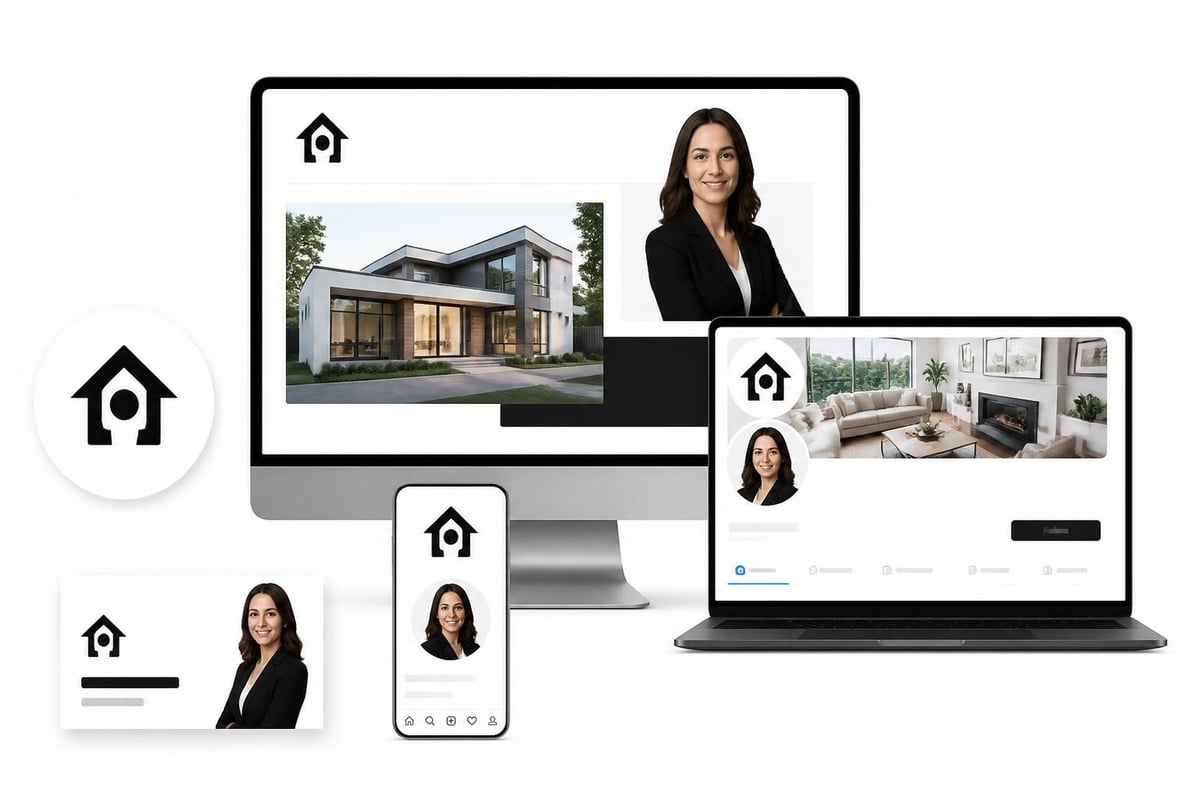
Creating a Comprehensive Brand Toolkit
Developing a cohesive brand toolkit ensures consistent realtor icon usage across all marketing materials and client touchpoints. This systematic approach prevents formatting errors, maintains professional standards, and streamlines the creation of new marketing assets.
A well-constructed toolkit includes approved logo files in various formats (EPS, PNG, SVG, JPG), colour specifications, typography guidelines, and usage examples. Building a visual branding toolkit that agents actually use requires attention to accessibility, organisation, and practical application scenarios.
Essential Toolkit Components
File format variety ensures compatibility across different design software and applications. Vector formats (EPS, SVG) allow unlimited scaling without quality loss, essential for large-format printing like billboards or banners. Raster formats (PNG, JPG) serve digital applications where specific pixel dimensions are required.
Colour profile documentation prevents colour shift across different media. CMYK values for print, RGB values for digital, Pantone specifications for specialty printing, and hexadecimal codes for web design all ensure colour consistency regardless of production method.
Template library accelerates marketing material creation whilst maintaining brand standards:
- Business card templates with correct icon placement
- Letterhead designs incorporating the realtor icon
- Email signature formats for consistent digital communication
- Social media post templates featuring proper branding
- Property flyer layouts with appropriate icon integration
- Presentation slide decks with branded elements
The Dakota-Maryland REALTORS® toolkit guidelines demonstrate practical implementation of these principles, offering downloadable resources that members can immediately deploy across their marketing efforts.
Common Usage Mistakes and How to Avoid Them
Even experienced real estate professionals occasionally misuse the realtor icon, often unknowingly violating trademark guidelines. Understanding these common pitfalls prevents legal issues and maintains the mark's professional integrity.
Descriptive Use Violations
One prevalent mistake involves using "realtor" as a descriptive term rather than a proper adjective. The GAAR blog explains three core trademark rules, emphasising that REALTOR® must always modify a noun (e.g., "REALTOR® agent" or "REALTOR® member") and never stand alone as a generic descriptor.
Incorrect usage examples:
- "Your trusted realtor" (missing proper noun)
- "Top realtor in Sydney" (descriptive misuse)
- "Realtor services available" (generic application)
Correct usage examples:
- "Your trusted REALTOR® professional"
- "Award-winning REALTOR® agent serving Sydney"
- "REALTOR® member providing comprehensive services"
Formatting and Capitalisation Errors
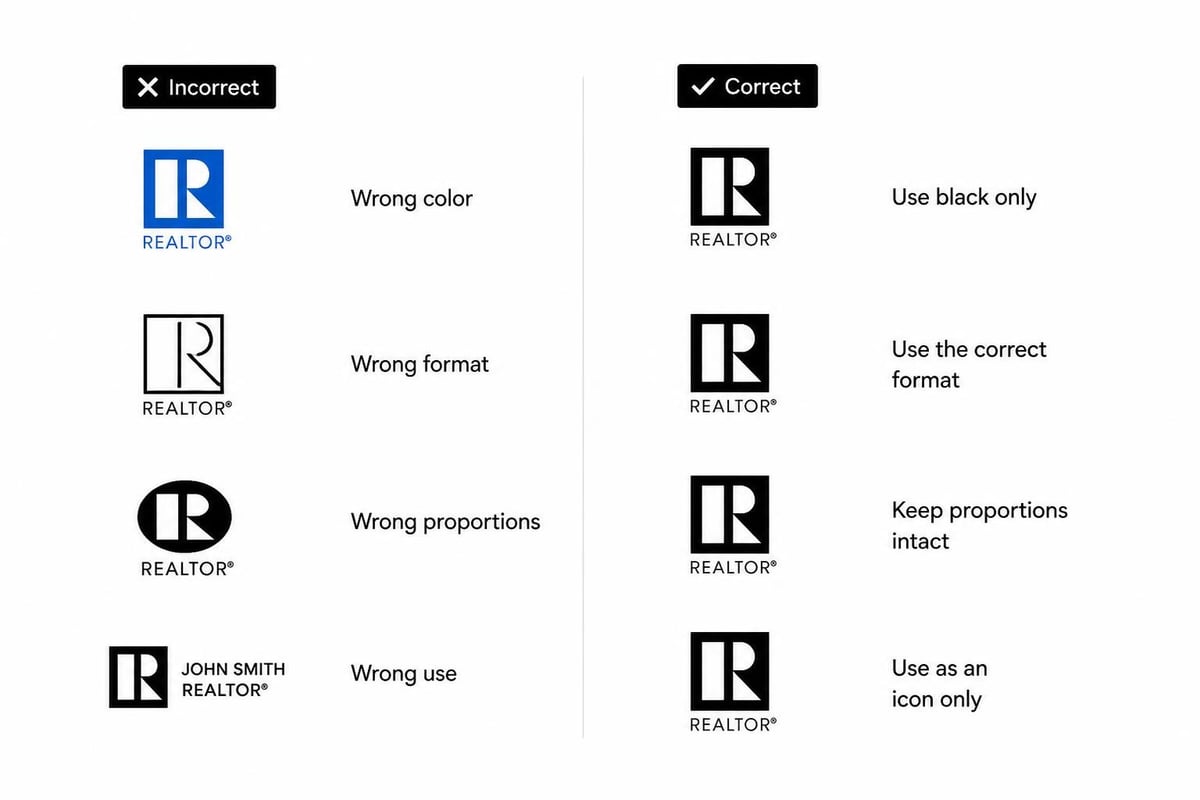
The REALTOR® mark requires specific formatting that many agents overlook. The registered trademark symbol (®) must appear in superscript after the final "R" in all written instances. Capitalisation must remain consistent – all capital letters, never lowercase or mixed case.
Digital platforms sometimes complicate proper formatting. When technical limitations prevent superscript display, parenthetical notation "(R)" serves as an acceptable alternative. Social media character limits don't excuse omitting the registration mark; proper formatting maintains legal protection and brand standards.
Regional Considerations and Australian Context
Whilst the REALTOR® trademark originates from American professional organisations, Australian real estate professionals often incorporate this designation when holding international memberships or operating in markets where NAR affiliation adds credibility.
Australian agents must navigate different professional frameworks, with state-based licensing through bodies like Fair Trading NSW and professional associations like the Real Estate Institute of Australia (REIA). When buying homes or selling properties in Australian markets, clients typically prioritise local licensing credentials over international affiliations.
Balancing Multiple Professional Designations
Real estate professionals holding multiple credentials face the challenge of incorporating various professional icons without creating visual clutter. Strategic hierarchy ensures the most relevant certifications receive prominent placement whilst maintaining clean, professional design.
Consider these principles when displaying multiple icons:
- Primary positioning: Place the most locally relevant credential in the most prominent position
- Consistent sizing: Maintain proportional relationships between different professional marks
- Grouped placement: Cluster certifications together rather than scattering them across materials
- Contextual relevance: Feature different credentials based on the specific marketing piece's purpose
For agents serving the Padstow, Revesby, and Panania areas, local market knowledge and community connections often matter more to clients than international designations. Balancing global credentials with local expertise creates comprehensive professional positioning.
Video and Multimedia Applications
As video content dominates digital marketing, understanding realtor icon placement in multimedia productions ensures brand consistency across emerging channels. The NAR video toolkit provides visual guidance on proper formatting for video applications.
Video Integration Strategies
Opening and closing frames offer natural opportunities for realtor icon display. Lower-third graphics during property tours can include subtle branding elements without distracting from featured homes. Video thumbnails on YouTube, Facebook, and property portals should incorporate the icon to build brand recognition before viewers even click play.
Motion graphics require additional consideration. Animated logos must maintain aspect ratios and colour accuracy throughout transitions. Transparency effects should never reduce the icon's legibility or alter its specified colours. Background choices must provide sufficient contrast for clear visibility.
Virtual Tour and 3D Presentation Branding
Virtual tours and 3D property presentations have become standard marketing tools. Incorporating the realtor icon into these immersive experiences reinforces brand presence without disrupting the viewer's exploration of the property.
Watermark placement in screen corners maintains visibility whilst remaining unobtrusive. Loading screens offer opportunities for full-scale logo display. Navigation menus can include branded elements that remind viewers of the agent's professional credentials throughout their virtual property experience.
Print Marketing Material Standards
Despite digital dominance, print materials remain essential for real estate marketing. Business cards, property brochures, signage, and direct mail pieces all require proper realtor icon implementation following established guidelines.
Business Card Design Principles
Business cards serve as tangible brand ambassadors that potential clients keep and reference. The realtor icon typically appears near the agent's name or in the card's bottom corner, maintaining hierarchy with agency branding whilst ensuring visibility.
Recommended business card specifications:
| Element | Guideline | Rationale |
|---|---|---|
| Icon size | Minimum 6mm height | Ensures legibility |
| Clear space | Equal to icon height | Prevents crowding |
| Colour accuracy | REALTOR® Blue or monochrome | Brand consistency |
| Placement | Top right or bottom left | Visual balance |
Professional printing services must receive proper colour specifications to match REALTOR® Blue accurately. Requesting colour proofs before full production runs prevents costly reprinting due to colour inconsistencies.
Property Signage and Large Format Applications
For Sale signs, billboards, and building wraps present unique scaling challenges. The realtor icon must remain proportional to other design elements whilst maintaining sufficient size for roadside visibility. When buyers explore properties for sale, clear branding on signage creates immediate professional recognition.
Outdoor applications face environmental considerations including sun exposure, weather resistance, and viewing distance. Materials and printing methods must preserve colour accuracy despite harsh Australian conditions. UV-resistant inks prevent fading that could alter the distinctive REALTOR® Blue shade.
Maintaining Brand Consistency Across Team Members
Real estate teams and agencies face additional complexity ensuring every team member properly represents the realtor icon. Centralised brand management, regular training, and accessible resources prevent inconsistent implementation across multiple agents.
Team Branding Hierarchies
Agencies must balance individual agent branding with overarching firm identity. The realtor icon appears at both levels – individual agents display it confirming personal membership whilst agency branding may incorporate it when the firm itself holds institutional membership.
Creating tiered brand systems allows agents personality and differentiation whilst maintaining cohesive professional standards:
- Agency master brand: Primary logo incorporating realtor icon when applicable
- Agent sub-brands: Individual variations following agency guidelines
- Property-specific materials: Campaign branding balancing agency, agent, and property focus
- Digital profiles: Consistent icon usage across individual agent social accounts
Regular brand audits identify inconsistencies before they proliferate. Quarterly reviews of marketing materials, digital assets, and client-facing documents ensure ongoing compliance with both agency standards and NAR guidelines.
Training and Resource Distribution
New team members require onboarding that covers proper realtor icon usage. Including brand guidelines training in agent orientation prevents errors from the outset. Ongoing education addresses updates to NAR standards and reinforces consistent implementation.
Cloud-based asset libraries ensure every team member accesses current, approved logo files. Version control prevents outdated icons from appearing in new materials. Access controls allow monitoring of who downloads which assets, facilitating troubleshooting when inconsistencies emerge.
Future Evolution and Digital Adaptation
The realtor icon continues evolving to meet changing technological landscapes whilst preserving its core brand identity. Understanding anticipated developments helps professionals prepare for coming changes and maintain cutting-edge brand presentation.
Emerging Platform Considerations
New social platforms, augmented reality applications, virtual reality property tours, and metaverse real estate ventures all present novel contexts for realtor icon display. NAR regularly updates guidelines to address these emerging technologies whilst maintaining brand consistency.
Responsive design principles ensure the realtor icon maintains legibility and impact across device sizes from smartwatches to large-screen displays. Scalable vector formats become increasingly important as display resolutions continue advancing and new form factors emerge.
Accessibility and Inclusive Design
Modern brand standards increasingly emphasise accessibility, ensuring realtor icon visibility for audiences with visual impairments or colour blindness. Alternative text descriptions for digital applications, sufficient colour contrast ratios, and compatibility with screen readers make the mark accessible to all potential clients.
These considerations particularly matter when providing real estate agent services to diverse client populations. Professional agents prioritise inclusive communication that serves every community member effectively.
Strategic Implementation for Maximum Impact
Beyond mere compliance, strategic realtor icon implementation amplifies brand impact and enhances professional credibility. Thoughtful placement, consistent execution, and contextual relevance transform the mark from simple legal requirement into powerful marketing asset.
Building Trust Through Certification Display
The realtor icon signals ethical commitment and professional accountability. Prominently displaying this mark reassures clients that their agent adheres to industry-leading standards and provides recourse through professional oversight bodies if issues arise.
When clients research top realtors near them, visible certification marks help distinguish qualified professionals from unlicensed practitioners. This differentiation becomes particularly important in competitive markets where numerous agents vie for client attention.
Strategic placement ensures the realtor icon appears at key decision points in the client journey:
- Initial contact materials: Business cards, email signatures, website headers
- Consideration stage content: Property listings, market reports, professional profiles
- Decision stage communications: Contracts, agreements, official correspondence
- Post-transaction materials: Testimonial requests, referral programs, ongoing newsletters
Each touchpoint reinforces professional credentials and ethical commitment, building cumulative trust throughout the client relationship. Obtaining a comprehensive property appraisal and market assessment from a certified REALTOR® professional provides clients confidence in receiving accurate, ethical guidance backed by professional accountability.
Proper realtor icon usage combines legal compliance, brand consistency, and strategic marketing to enhance professional credibility across all client touchpoints. Whether you're establishing your personal brand, managing team standards, or adapting to emerging digital platforms, understanding and implementing these guidelines protects your professional reputation whilst maximising marketing impact. For property owners in Revesby, Padstow, and Panania seeking exceptional results backed by proven expertise and straightforward communication, Steven Cirillo delivers personalised service with the professionalism and market knowledge that drive outstanding outcomes across every transaction.