
Your digital presence as a real estate professional has become the cornerstone of client acquisition and trust-building. Realtor websites serve as 24/7 showcases for properties, expertise, and market knowledge, transforming casual browsers into committed buyers and sellers. In Australia's competitive property landscape, particularly across Sydney's western suburbs including Padstow, Revesby, and Panania, an effective website doesn't simply display listings-it establishes credibility, demonstrates local expertise, and creates meaningful connections with prospective clients before the first conversation begins.
The Foundation of Modern Realtor Websites
Building a successful online presence requires understanding that realtor websites function as both marketing tools and service platforms. These digital storefronts must balance aesthetic appeal with functional efficiency whilst meeting strict compliance standards.
Technical Infrastructure Requirements
Every professional real estate website needs robust technical foundations to perform reliably. Security stands paramount when handling client information and property details. Implementing proper HTTPS/TLS configuration protects sensitive data throughout all client interactions, from initial enquiries to document exchanges.
Performance optimisation directly impacts both user satisfaction and search engine rankings. Google's mobile-first indexing means your site’s mobile performance determines how well it ranks across all devices. Page speed matters particularly for property listing pages where potential buyers expect instant access to photos, floor plans, and essential details.
Core technical elements include:
- HTTPS encryption across all pages
- Responsive design that adapts seamlessly to tablets and smartphones
- Fast loading times (under 3 seconds for initial page load)
- Regular security updates and vulnerability patches
- Automated backups protecting against data loss

Database integration enables dynamic property displays and sophisticated search functionality. Whether you're showcasing property listings across Revesby and surrounding areas or highlighting recent sales successes, your database structure determines how efficiently visitors find relevant properties.
Essential Features That Drive Results
The difference between mediocre and exceptional realtor websites often comes down to specific functionality that addresses genuine client needs.
Advanced Property Search Capabilities
Modern buyers and sellers expect sophisticated search tools that go beyond basic filters. Your property search should accommodate diverse criteria including:
| Search Category | Key Filters | Purpose |
|---|---|---|
| Location | Suburb, postcode, radius, school zones | Neighbourhood targeting |
| Property Type | House, townhouse, duplex, land | Matching buyer preferences |
| Price & Features | Range, bedrooms, bathrooms, parking | Budget and lifestyle fit |
| Special Features | Pool, granny flat, renovated, views | Unique requirements |
IDX (Internet Data Exchange) integration allows displaying MLS listings whilst maintaining proper compliance with industry standards. For agents operating in competitive markets, this functionality expands your website's inventory without manually entering each property.
Interactive map search transforms how prospective buyers explore neighbourhoods. Rather than scrolling through lists, users can visualise property locations relative to schools, transport, shopping centres, and other amenities they value. This geographical context proves particularly valuable when helping first home buyers understand different suburbs within their budget range.
Lead Capture and Contact Systems
Converting website visitors into active leads requires strategically placed, thoughtfully designed contact opportunities. Research from user experience experts demonstrates that form design significantly impacts completion rates.
Effective lead capture implements multiple touchpoints:
- Property enquiry forms on individual listings
- Appraisal request forms for sellers considering the market
- Newsletter subscriptions for market updates and new listings
- Callback scheduling for convenience-focused prospects
- Live chat during business hours for immediate questions
Each form should request only essential information. Asking for name, email, phone, and specific interest creates sufficient follow-up opportunity without creating friction that abandons incomplete submissions.

Professional Content That Establishes Authority
Content marketing through realtor websites positions you as the local market expert. Regular blog posts about current real estate market trends, neighbourhood profiles, and property buying or selling advice demonstrate knowledge whilst improving search visibility.
Suburb profiles showcase your intimate understanding of specific areas. For an agent specialising in Padstow, Revesby, and Panania, detailed content about each suburb's character, amenities, schools, transport, recent sales, and market trajectory proves invaluable to researching buyers.
Compliance and Accessibility Standards
Operating realtor websites in 2026 means navigating complex regulatory requirements that protect both consumers and fair housing principles.
Fair Housing and Advertising Compliance
Digital advertising carries specific obligations under fair housing legislation. HUD’s guidance on digital platforms outlines critical considerations for property descriptions, imagery, and targeting parameters.
Your website content must avoid discriminatory language or imagery. This extends beyond obvious violations to subtle suggestions through word choice, photo selection, or demographic targeting in paid advertising campaigns.
Compliance checklist for property listings:
- Describe properties factually without implying preferred tenant characteristics
- Use photos showing homes without emphasising or excluding any protected class
- Avoid terms referencing family status, religion, national origin, or other protected categories
- Ensure virtual tours and videos maintain neutral presentation
- Review automated ad targeting to prevent discriminatory delivery
Website Accessibility Requirements
Creating inclusive digital experiences isn't just ethical-it's increasingly mandatory. WCAG 2.2 guidelines establish the international standard for web accessibility, ensuring people with disabilities can navigate and use your site effectively.
Practical accessibility improvements benefit all users whilst ensuring compliance:
- Proper heading hierarchy for screen reader navigation
- Alternative text descriptions for all property images
- Sufficient colour contrast between text and backgrounds
- Keyboard navigation for all interactive elements
- Captioning or transcripts for video content
- Clear, consistent navigation structure
When showcasing property listings and marketing materials, accessible design ensures prospective buyers with vision, hearing, motor, or cognitive differences can fully engage with your offerings. This expanded reach translates directly to additional opportunities.
User Experience Design Principles
The architecture and flow of realtor websites dramatically influence whether visitors stay, explore, and ultimately make contact.
Navigation Structure and Information Architecture
Visitors should find what they seek within three clicks. Clear primary navigation typically includes:
- Buy (property search and buyer resources)
- Sell (appraisal requests, selling process, recent sales)
- Suburbs (area profiles and local expertise)
- About (agent background, testimonials, approach)
- Contact (multiple contact methods and office details)
Secondary navigation accommodates specific buyer segments. First home buyers, investors, and families upgrading to larger homes each have distinct needs and questions. Tailored landing pages address these specific audiences with relevant information.
| Visitor Type | Primary Interest | Key Content Needed |
|---|---|---|
| First Home Buyers | Affordability, process guidance | Entry-level listings, buyer's guide, finance tips |
| Upgraders | Larger homes, selling current property | Family homes, selling strategies, market timing |
| Downsizers | Maintenance-free, lifestyle change | Townhouses, low-maintenance properties, transition advice |
| Investors | Returns, growth potential | Investment properties, rental yields, suburb growth data |
Breadcrumb navigation helps users understand their location within your site structure whilst providing easy backtracking. This proves particularly valuable on property listing pages where visitors often compare multiple properties.
Mobile-First Experience Design
With the majority of property searches now beginning on smartphones, mobile optimisation isn't optional. Mobile-first indexing means Google primarily uses your mobile site version for ranking and indexing.
Touch-friendly interfaces require larger tap targets, adequate spacing between interactive elements, and streamlined forms. Property photos should load quickly even on cellular connections whilst maintaining sufficient quality for initial impression.
Phone number prominence on mobile layouts enables instant connection. Tap-to-call functionality removes friction when prospective clients want immediate conversation about a listing that interests them.
Content Strategy for Realtor Websites
Effective content serves dual purposes: attracting organic search traffic whilst demonstrating expertise that converts visitors into clients.
Property Listings That Sell
Individual listing pages represent prime conversion opportunities. Each property deserves comprehensive presentation including:
- High-quality photography showcasing every room and outdoor space
- Detailed descriptions highlighting features, renovations, and lifestyle benefits
- Accurate specifications covering land size, building area, and room dimensions
- Interactive floor plans helping visualise layout and flow
- Location information about nearby schools, shops, and transport
- Virtual tours or video walkthroughs for interstate or international buyers
Writing compelling property descriptions requires balancing enthusiasm with accuracy. Focus on tangible features and genuine benefits rather than empty superlatives. A renovated kitchen with stone benchtops and quality appliances provides more value than simply calling it "stunning."
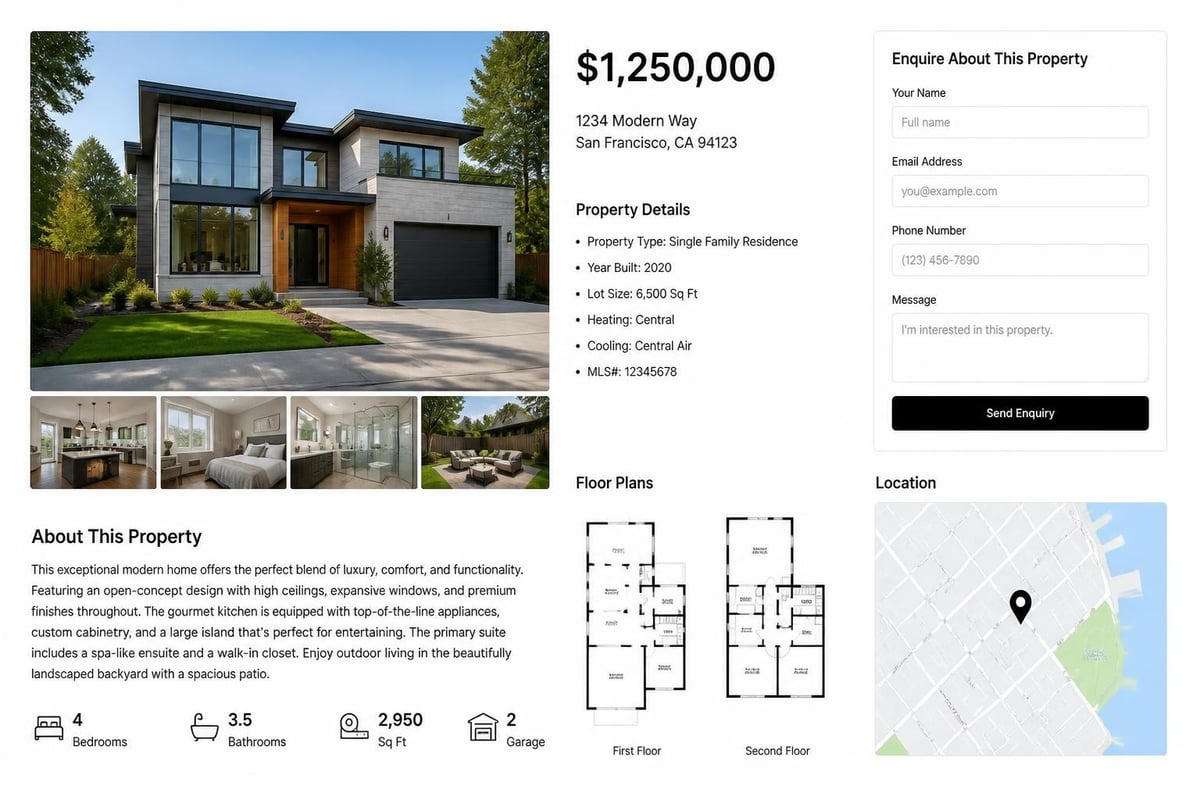
When managing property marketing and sales strategy, consistent presentation across all listings reinforces professionalism whilst helping buyers compare properties efficiently.
Educational Resources and Market Insights
Positioning yourself as a trusted advisor requires sharing knowledge freely. Educational content addresses common questions and concerns your target audience faces:
- Detailed buying and selling process guides
- Market report summaries with local statistics
- Suburb comparison articles for area shoppers
- Seasonal market trend analysis
- Property investment fundamentals
- Home presentation and styling advice
This content serves long-term SEO goals whilst providing immediate value. Someone researching "best suburbs for families near Padstow" might not purchase for six months, but finding your authoritative suburb comparison establishes you as their preferred agent when they're ready.
Regular market updates demonstrate active market participation. Monthly commentary on local sales, price trends, and inventory levels shows you're engaged, informed, and capable of providing current advice rather than outdated assumptions.
Integration with Marketing Channels
Realtor websites function as the hub connecting various marketing efforts into a cohesive system.
Social Media and Digital Advertising
Facebook, Instagram, and LinkedIn each offer targeting capabilities for reaching potential buyers and sellers. All paid campaigns should direct traffic to specific landing pages on your website rather than social profiles.
Property promotion campaigns link to individual listing pages optimised for conversion. Appraisal campaigns direct to dedicated pages explaining your valuation process and local market expertise. Brand awareness efforts might target your about page or recent success stories.
Retargeting campaigns re-engage website visitors who didn't initially convert. Someone who browsed multiple properties but didn't enquire might respond to a well-timed ad highlighting a new listing matching their search criteria.
Email Marketing Integration
Website newsletter subscriptions feed your email marketing database with engaged prospects. Automated welcome sequences introduce new subscribers to your services, expertise, and current market insights.
Segmented email campaigns deliver relevant content based on subscriber interests:
- New listing alerts for active buyers matching specific criteria
- Market updates for sellers monitoring optimal timing
- Neighbourhood news for location-specific subscribers
- Investment insights for property investor audiences
Each email should link back to relevant website content, driving traffic whilst providing value. A market update email might reference your latest blog post analysing recent sales data, encouraging deeper engagement.
Performance Metrics and Continuous Improvement
Successful realtor websites require ongoing optimisation based on actual user behaviour and conversion data.
Essential Analytics and Tracking
Understanding how visitors interact with your site reveals opportunities for improvement. Key metrics include:
Traffic metrics:
- Total visitors and unique users
- Traffic sources (organic search, social, direct, referral)
- Top landing pages attracting new visitors
- Device breakdown (mobile, desktop, tablet)
Engagement metrics:
- Average session duration
- Pages per session
- Bounce rate by page type
- Most viewed property listings
Conversion metrics:
- Form completion rates
- Contact method preferences
- Appraisal request volume
- Newsletter subscription growth
Monitoring Core Web Vitals through performance tools identifies technical issues impacting user experience. Slow loading times, layout shifts, or delayed interactivity all reduce conversion rates and search rankings.
Testing and Optimisation Approaches
Systematic improvement requires methodical testing of design elements, copy, and functionality. A/B testing compares two versions of a page element to determine which performs better.
Test candidates include:
- Lead form length and field requirements
- Call-to-action button text and placement
- Property search filter organisation
- Hero image selection and headline copy
- Trust signal placement (testimonials, accreditations, awards)
Even modest conversion rate improvements compound significantly. Increasing enquiry form completion from 3% to 4% represents a 33% increase in leads from the same traffic volume.
Regular content audits identify outdated information requiring updates. Market statistics, suburb profiles, and process guides should reflect current conditions and regulations rather than historical data that undermines credibility.
Building Trust Through Transparency
Modern consumers research extensively before contacting real estate professionals. Your website must address their questions and concerns proactively.
Agent Profile and Credentials
Comprehensive agent profiles humanise your service whilst establishing qualifications. Include:
- Professional background and experience
- Areas of specialisation and geographical focus
- Industry accreditations and ongoing education
- Personal philosophy and approach to client service
- Community involvement and local knowledge
Authentic photography presents you as approachable and professional. Staged corporate headshots feel artificial compared to natural images showing you engaged in your work or community.
Video introductions create stronger connections than text alone. A brief video explaining your approach, experience, and commitment to client success helps prospective clients determine if your style matches their preferences before initial contact.
Social Proof and Testimonials
Third-party validation reassures uncertain prospects. Client testimonials, particularly those mentioning specific outcomes and experiences, demonstrate your ability to deliver results.
Effective testimonials include:
- Client names and suburbs (with permission)
- Specific results achieved (sale price, timeframe, process smoothness)
- Particular aspects of service they valued
- The type of property transaction (first home, family upgrade, investment)
Recent sales showcase active market success. Displaying sold properties with achieved prices demonstrates current capability rather than historical performance. For sellers considering the market, seeing similar properties in their suburb recently sold builds confidence in your local expertise.
Industry awards and recognition provide objective credibility. Media features, professional association accolades, and performance rankings validate your standing within the industry.
Future-Proofing Your Digital Presence
Technology and consumer expectations continue evolving. Forward-thinking realtor websites anticipate trends whilst maintaining current functionality.
Emerging Technologies and Features
Virtual and augmented reality technologies transform property viewing. While full VR implementations remain specialised, 360-degree photography and virtual staging have become accessible and expected.
Artificial intelligence applications include:
- Chatbots providing instant responses to common questions outside business hours
- Personalised property recommendations based on browsing behaviour
- Automated property valuation estimates for instant seller engagement
- Predictive analytics identifying prospects most likely to transact soon
Voice search optimisation addresses the growing percentage of property searches conducted through smart speakers and voice assistants. Natural language content answering specific questions ("What are houses selling for in Revesby?") captures this traffic.
Maintaining Relevance and Security
Regular content updates signal active involvement to both visitors and search engines. Fresh blog posts, updated market statistics, and new property listings demonstrate ongoing activity rather than abandoned presence.
Security best practices from OWASP should guide development decisions and maintenance procedures. Client data protection isn't just regulatory compliance-it's fundamental trust that determines whether prospects feel safe sharing personal information.
Platform and plugin updates address security vulnerabilities whilst improving functionality. Delayed updates create exposure to known exploits that compromise site integrity and client information.
Professional monitoring detects issues before they impact visitors. Uptime monitoring alerts you to outages, broken forms, or technical errors that prevent lead capture. Regular testing across different devices and browsers ensures consistent functionality.
Building and maintaining effective realtor websites requires balancing technical performance, compliance requirements, user experience, and compelling content that establishes market expertise. For sellers and buyers throughout Sydney's western suburbs, a professional digital presence provides the first impression of the service and results they can expect. Steven Cirillo combines comprehensive property marketing with strategic online presence to deliver exceptional outcomes for clients across Padstow, Revesby, and Panania. His detail-oriented approach extends from property presentation through digital strategy, ensuring every aspect of the selling or buying process exceeds expectations.