
Understanding the phrase "you real estate" captures the deeply personal nature of property ownership and transactions. Your property journey isn't just about bricks and mortar-it's about building wealth, creating homes, and making decisions that shape your financial future. Whether you're considering your first purchase, upgrading to a family home, or selling an investment property, the decisions you make today will resonate for years to come. The Australian property market in 2026 presents unique opportunities and challenges that require careful navigation, local expertise, and strategic thinking.
Understanding Your Real Estate Position in Today's Market
The concept of you real estate begins with recognising where you currently stand in the property landscape. Every homeowner, buyer, and seller has a unique position influenced by market conditions, personal circumstances, and financial capacity. In suburbs like Revesby, Padstow, and Panania, the local market dynamics differ significantly from broader Sydney trends, making personalised advice essential.
Your property position depends on several interconnected factors that shape your options and opportunities. Market equity plays a crucial role-how much your current property is worth compared to what you owe determines your purchasing power. Life stage considerations influence whether you're looking to upsize, downsize, or invest. Financial readiness encompasses your deposit, borrowing capacity, and cash reserves for transaction costs.

Assessing Your Current Property Value
Knowing your property's true market value forms the foundation of any real estate decision. Many homeowners rely on outdated valuations or online estimates that fail to capture recent market movements and property-specific features. Accurate property appraisals backed by local sales data and market knowledge provide the clarity needed for confident decision-making.
Professional appraisals consider multiple dimensions beyond simple price-per-square-metre calculations:
- Recent comparable sales in your immediate area
- Property condition and presentation standards
- Unique features that add or detract from value
- Current market sentiment and buyer demand levels
- Upcoming infrastructure or development impacts
The difference between an informed valuation and a hopeful estimate can amount to tens of thousands of dollars. Research from the Federal Housing Finance Agency demonstrates that house price movements vary significantly at the local level, even within the same metropolitan area. This variation underscores why suburb-specific knowledge matters when assessing you real estate worth.
Strategic Approaches to Buying Your Real Estate
Purchasing property represents one of life's most significant financial commitments. The buying process in 2026 requires more sophistication than simply finding a property you like and making an offer. Successful buyers approach the market with clear strategies, comprehensive research, and professional guidance.
First Home Buyer Considerations
First-time buyers face unique challenges navigating unfamiliar territory. Understanding the complete buying process helps avoid costly mistakes and missed opportunities. First home buyer guidance provides essential support through each stage, from initial property searches through to settlement.
The Consumer Financial Protection Bureau offers valuable resources on mortgage shopping, though Australian buyers should consult local financial advisors for market-specific advice. Key first-buyer priorities include:
- Establishing realistic budgets that account for purchase price, stamp duty, and ongoing costs
- Securing pre-approval to understand borrowing capacity before house hunting
- Researching target suburbs thoroughly to identify areas matching lifestyle and investment goals
- Building inspection contingencies into offers to protect against hidden defects
- Understanding contract terms and cooling-off periods specific to NSW property law
Many first-time buyers underestimate the importance of location choice on long-term value. Suburbs with strong infrastructure, quality schools, and transport connections typically demonstrate more resilient price growth over time.
Investment Property Strategy
Investment buyers approach you real estate decisions through a different lens, prioritising rental yields, capital growth potential, and tax implications. The investment landscape in 2026 rewards buyers who combine analytical rigour with local market insight.
| Investment Consideration | Questions to Address | Impact on Returns |
|---|---|---|
| Rental Yield | What weekly rent can the property achieve? | Immediate cash flow |
| Capital Growth | What drives long-term value appreciation in this area? | Wealth accumulation |
| Tenant Demand | How quickly does rental stock lease in this suburb? | Vacancy risk |
| Maintenance Costs | What ongoing expenses will the property require? | Net returns |
| Tax Position | How do depreciation and deductions affect overall yield? | After-tax returns |
Investment success depends heavily on understanding which suburbs offer the best balance between affordability and growth potential. Areas like Revesby and Padstow provide attractive entry points for investors seeking stable rental demand combined with capital growth prospects.
Maximising Value When Selling Your Real Estate
Selling property successfully requires strategic preparation, effective marketing, and skilled negotiation. The difference between an average sale and an outstanding result often comes down to how well you prepare and present your property to the market.
Property Presentation and Staging
First impressions significantly influence buyer perceptions and willingness to pay premium prices. Before listing your property, invest time and resources in presentation improvements that deliver measurable returns. Simple enhancements often yield disproportionate value increases.
High-impact presentation improvements include:
- Fresh paint in neutral, contemporary colours
- Thorough decluttering and depersonalisation
- Professional cleaning including carpets and windows
- Garden maintenance and kerb appeal enhancements
- Minor repairs to fixtures, fittings, and finishes
Research consistently shows that well-presented properties attract more buyer interest, generate stronger competition, and achieve higher sale prices. The investment in presentation typically returns several times its cost through improved sale results.

Marketing Your Property Effectively
Professional property marketing extends far beyond simply listing on real estate portals. Comprehensive campaigns combine multiple channels to maximise exposure and attract qualified buyers. Property Marketing & Sales Strategy creates tailored approaches that showcase each property's unique strengths through professional photography, video content, digital advertising, social media promotion, and database marketing to achieve optimal results.
Effective marketing campaigns incorporate:
- Professional photography that highlights your property's best features
- Video walkthroughs that engage interstate and international buyers
- Targeted digital advertising reaching buyers actively searching in your area
- Social media campaigns extending reach beyond traditional channels
- Email marketing to established buyer databases
The National Association of Realtors research indicates that buyers typically view multiple online listings before shortlisting properties for inspection. Your marketing must cut through the noise to capture attention and drive inspections.
Navigating the Transaction Process
Understanding the mechanics of property transactions helps you navigate the process confidently and avoid potential pitfalls. Whether buying or selling, knowing what to expect at each stage reduces stress and enables better decision-making.
Contract Negotiations and Terms
Negotiation represents a critical phase where preparation and expertise directly impact outcomes. Successful negotiations require understanding market conditions, buyer or seller motivations, and contractual implications. Strong negotiators achieve better prices, more favourable terms, and smoother transactions.
Key negotiation elements include:
- Price positioning based on comparable sales and current market conditions
- Settlement timing that accommodates both parties' requirements
- Conditional clauses protecting buyers while maintaining seller certainty
- Inclusions and exclusions clearly defining what transfers with the property
- Special conditions addressing specific circumstances or requirements
Working with experienced professionals ensures negotiations proceed strategically rather than emotionally. Data-driven discussions grounded in market evidence typically produce better outcomes than arbitrary positions.
Legal and Compliance Requirements
Property transactions involve substantial legal obligations and compliance requirements. Understanding these responsibilities protects you from potential liabilities and ensures smooth settlements. NSW property law establishes specific disclosure requirements and transaction protocols that must be followed precisely.
The Federal Register guidance on Fair Housing provides important context on discrimination and compliance considerations, though Australian sellers should consult local legal requirements. Critical compliance areas include:
- Section 66W certificates providing essential property information to buyers
- Building and pest inspection disclosure requirements
- Strata documentation for units and townhouses
- Planning certificates detailing zoning and development restrictions
- Contract cooling-off periods and associated rights
Failing to meet disclosure obligations can result in contract rescission, financial penalties, and legal disputes. Professional guidance ensures all requirements are satisfied properly.
Understanding Market Cycles and Timing
Property markets move through distinct cycles that create varying conditions for buyers and sellers. Recognising where the market sits within these cycles helps optimise timing for your real estate decisions. While perfectly timing the market proves impossible, understanding cyclical patterns enables more strategic choices.
Market Indicators to Monitor
Several key indicators provide insight into current market conditions and likely near-term trends. Savvy market participants track these metrics to inform their decision-making and identify optimal timing windows.
| Indicator | What It Measures | What It Tells You |
|---|---|---|
| Days on Market | Average time properties take to sell | Buyer demand strength |
| Clearance Rates | Percentage of auction properties selling | Market heat and competition |
| Stock Levels | Number of properties available for sale | Supply-demand balance |
| Price Growth | Quarterly and annual price movements | Market direction and momentum |
| Auction Competition | Number of registered bidders per property | Buyer activity levels |
Freddie Mac’s House Price Index provides useful methodology for understanding price trend analysis, though Australian buyers should reference local data from sources like CoreLogic and Domain for relevant market intelligence.
Seasonal Considerations
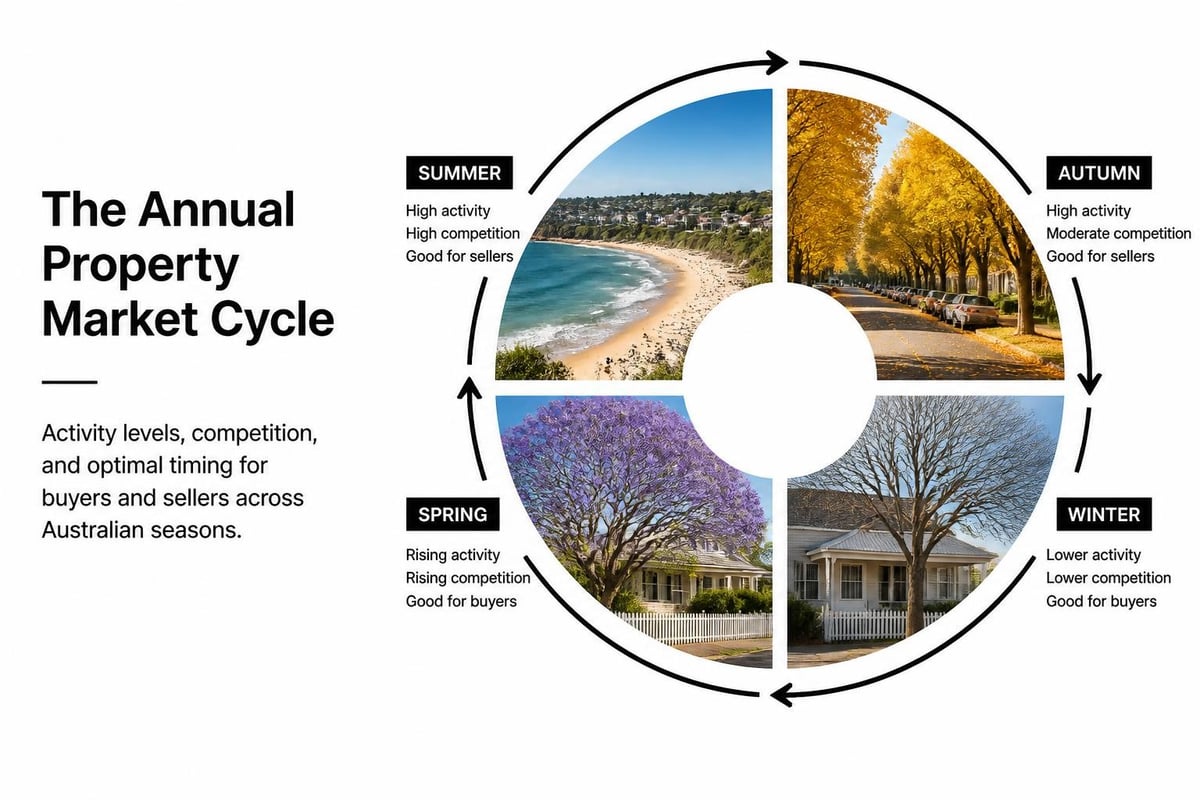
The Australian property market exhibits clear seasonal patterns that influence both buyer activity and sale results. Understanding these patterns helps sellers choose optimal listing times and buyers identify periods with potentially better negotiating leverage.
Spring (September-November) traditionally represents the strongest selling season, with increased buyer activity, higher auction clearance rates, and strong competition. Properties presented well during spring typically achieve premium results.
Summer (December-February) sees activity slow during the holiday period, though motivated buyers often face less competition. Sellers willing to campaign through summer can sometimes achieve excellent results from serious purchasers.
Autumn (March-May) provides a second strong selling window as buyers return to the market after summer. Clear skies and pleasant weather support property presentation and inspection activity.
Winter (June-August) generally experiences reduced buyer numbers and lower competition. However, motivated sellers can still achieve strong results, and buyers may find better negotiating opportunities.
Building Long-Term Property Wealth
Successful you real estate strategies extend beyond single transactions to encompass long-term wealth building through property. The most successful property participants think strategically about how each decision fits within broader financial objectives and wealth-creation plans.
Portfolio Development Strategies
Growing a property portfolio requires careful planning, disciplined execution, and patience. Successful investors build equity systematically, using existing properties to fund subsequent purchases while maintaining sustainable debt levels and cash flow.
Portfolio growth approaches include:
- Equity leveraging to fund deposits on additional properties without selling existing assets
- Diversification across different suburb types and property categories
- Renovation strategies to accelerate equity growth through value-adding improvements
- Development opportunities for experienced investors seeking higher returns
- Market timing to buy during favourable conditions and avoid overpaying at peaks
Census Bureau housing data provides valuable demographic context for understanding housing demand patterns, though Australian investors should focus on local population growth and migration trends when evaluating long-term potential.
The Urban Institute’s research on housing supply dynamics offers important insights into factors driving price trends, helping investors identify markets with favourable supply-demand characteristics for sustained growth.
Tax Considerations and Planning
Property ownership creates various tax implications that significantly impact overall returns. Understanding these tax dimensions and planning accordingly maximises after-tax wealth accumulation. Australian property investors should consult qualified tax advisors to optimise their positions within current legislation.
Key tax considerations include capital gains tax on investment property sales, depreciation deductions on building and fixtures, negative gearing benefits when expenses exceed income, and land tax obligations on investment holdings. The U.S. Code section 121 provides context on principal residence exclusions in American markets, though Australian rules differ substantially.
Strategic tax planning can substantially improve investment returns over time. Working with property-specialised accountants ensures you claim all available deductions while maintaining proper compliance with Australian Taxation Office requirements.
Working with Real Estate Professionals
The complexity of modern property transactions makes professional guidance increasingly valuable. Whether buying or selling, working with experienced professionals who understand local markets and prioritise client interests delivers measurable benefits through better outcomes and reduced stress.
Selecting the Right Agent
Choosing an agent represents one of your most important you real estate decisions. The right professional brings local market expertise, proven negotiation skills, comprehensive marketing capabilities, and a client-focused approach that prioritises your objectives above all else.
Essential agent qualities to evaluate include:
- Local market knowledge demonstrated through recent sales and suburb expertise
- Communication style that matches your preferences and keeps you informed
- Marketing approach utilising professional resources and multi-channel campaigns
- Negotiation skills evidenced by consistently strong sale results
- Client testimonials reflecting satisfaction with service and outcomes
Understanding what makes excellent agents helps you make informed selection decisions. Don't hesitate to interview multiple agents before committing to ensure you find the right professional partnership for your needs.
Understanding Agent Services and Value
Professional real estate services encompass far more than simply listing properties or arranging inspections. Comprehensive agent support includes accurate market appraisals, strategic pricing advice, professional marketing campaigns, skilled negotiation, transaction management, and settlement coordination.
The value delivered by skilled agents typically far exceeds their commission through higher sale prices, faster transactions, and reduced seller stress. Research on property agent pricing demonstrates how professional services impact outcomes across different market conditions and property types.
Quality agents invest substantial resources in marketing, technology, professional development, and client support systems that individual sellers cannot replicate independently. This investment translates directly into better results for clients through increased buyer reach and stronger competition.
Energy Efficiency and Modern Property Features
Contemporary buyers increasingly prioritise energy efficiency, sustainability, and modern conveniences when evaluating properties. Understanding these preferences helps sellers position properties effectively and guides buyers toward homes offering long-term value and reduced operating costs.
Energy-Efficient Property Features
Energy-efficient homes deliver ongoing cost savings while reducing environmental impact. Modern buyers recognise these benefits and often pay premiums for properties with strong energy performance. The Department of Energy’s resources on efficient homes provide valuable context on energy performance standards and evaluation methods.
High-value energy features include:
- Solar panel installations reducing electricity costs
- High-efficiency heating and cooling systems
- Quality insulation in walls, ceilings, and floors
- Double-glazed windows minimising heat transfer
- LED lighting throughout the property
- Water-efficient fixtures and appliances
Properties incorporating these features typically achieve faster sales and stronger prices while offering buyers lower ongoing costs and improved comfort. Sellers should highlight energy-efficient features prominently in marketing materials to attract environmentally conscious buyers.
Smart Home Technology Integration
Smart home technology has evolved from luxury novelty to mainstream expectation among many buyers. Integration of connected devices for security, climate control, lighting, and entertainment enhances property appeal and functionality.
Buyers appreciate properties with security systems offering smartphone monitoring, programmable thermostats optimising energy use, automated lighting enhancing convenience and security, and integrated entertainment systems providing seamless connectivity. While not essential, these features increasingly influence buyer perceptions of property modernity and value.
Successfully navigating you real estate journey requires combining market knowledge, strategic thinking, and professional expertise to achieve optimal outcomes. Whether buying your first home, upgrading to accommodate a growing family, or selling an investment property, the decisions you make today shape your financial future for years to come. Real estate sales agent Steven Cirillo specialises in helping clients across Padstow, Revesby, and Panania achieve exceptional results through honest communication, detailed market knowledge, and a commitment to selling above expectations. Contact Steven today to discuss how strategic guidance can help you maximise returns and navigate your property journey with confidence.